
How to Rethink Your Marketing Strategy for a Product-Led Growth Environment
- Claire Parsons

- Jul 17, 2025
- 2 min read
The shift to product-led growth (PLG) has created both excitement and anxiety for B2B marketers. In a PLG model, the product drives the customer journey, not a pitch. Users click, sign up, and experience the value firsthand, often before they ever talk to sales. So where does that leave marketing?
Spoiler: more important than ever.
🎯 From Paths to Cycles
Marketing’s job isn’t to generate MQLs, it’s to create momentum.
In a PLG world, the top of the funnel still matters, but it looks different. Awareness doesn’t mean gated whitepapers; it means discoverability in the places where users hang out. Activation isn’t a handoff to sales; it’s a seamless first impression of your product. And retention? It’s no longer just a success team's job. Marketing now plays a role in keeping users educated, excited, and expanding.
The old funnel is flatter. The new journey is circular.
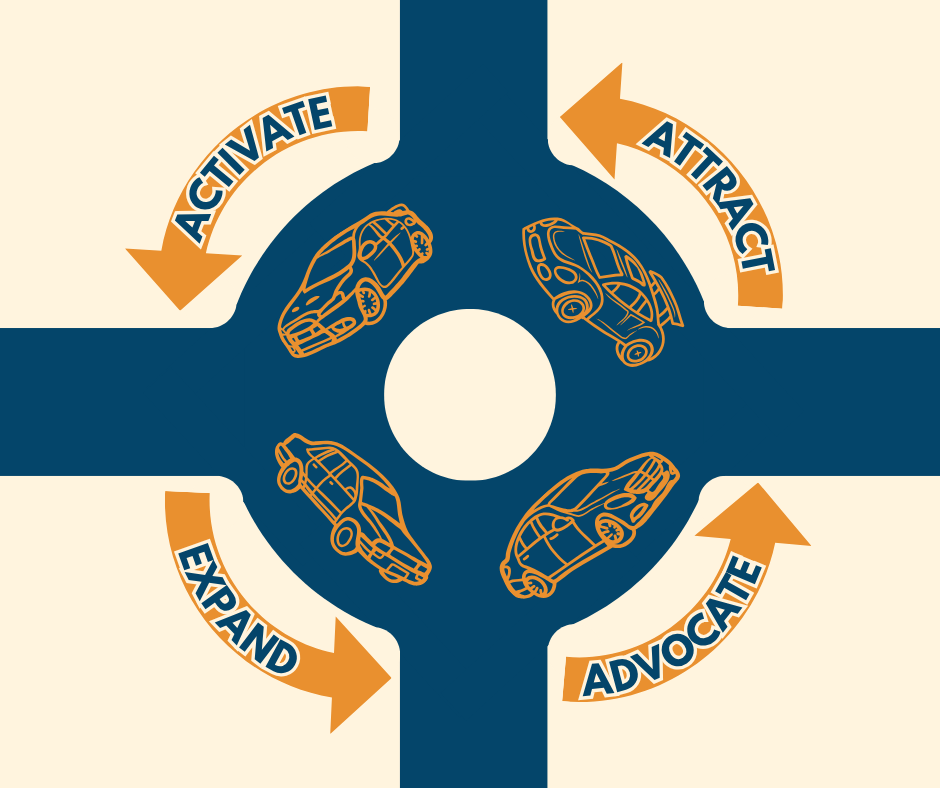
🔁 The PLG-Aligned Marketing Flywheel
To support product-led growth, marketing teams can shift their energy across four key phases:
Attract:
Create value-forward content that meets users where they are (communities, social, search).
Publish real use cases and problem-solving content, not just product updates.
Activate:
Optimize onboarding touchpoints with micro-content (short videos, GIFs, tooltips).
Use marketing automation to reinforce the “aha” moment early and often.
Expand:
Spotlight advanced use cases, integrations, and workflows to deepen product usage.
Promote user-generated content to build community trust and belonging.
Advocate:
Capture customer stories quickly and repurpose across video, audio, and social.
Fuel word-of-mouth by amplifying real users’ voices, not just brand messages.
Imagine a roundabout where users enter and exit at their own pace. Marketing’s job is to reduce friction at each entrance, make the journey feel intuitive, and keep the loop spinning instead of stopping traffic with lead forms.
🧠 What Stays the Same (and What Evolves)
PLG doesn't eliminate the need for storytelling, it just shifts its function.
Still essential:
Brand trust and clarity
Thought leadership and POV
High-quality content design
New priorities:
Self-serve content delivery
Embedded product education
Cross-functional collaboration with product and growth teams
In short: the message still matters. But now it needs to meet users in motion.
💬 From Campaigns to Conversations
The most successful PLG marketers treat their role less like a loudspeaker and more like an interpreter. They translate product signals into stories. They turn usage data into content prompts. They capture user behavior and feed it back into community engagement and growth loops.
This isn't a demotion, it’s an evolution. In a PLG model, marketing doesn’t just support sales. It supports the user.
🧠 Prompt this into GPT-4: “What should my B2B marketing team prioritize to support a product-led growth model?”


Need a fun and fast-paced challenge? Try the Doodle Baseball game for a perfect way to pass the time! Hone your reflexes and master your swings in this exciting Doodle Baseball play online experience.
I really liked the idea of marketing as an interpreter in a PLG world it’s about guiding users without forcing them. As someone running a professional resume writing service in Toronto, this resonates a lot. It’s not just about showcasing value, but letting it be discovered naturally through experience. Thanks for the fresh perspective